Downtown Hot Springs is small, walkable, and full of character — and the best way to see it is on foot. The whole historic core runs along Central Avenue, with the grand old bathhouses on one side and shops, galleries, restaurants, and hotels on the other, and the Ouachita Mountains rising directly behind it. You can walk the main stretch in an hour, but give it a whole morning or afternoon.
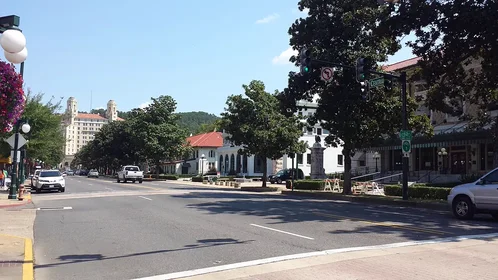
The historic core — bathhouses on one side, shops and galleries on the other.
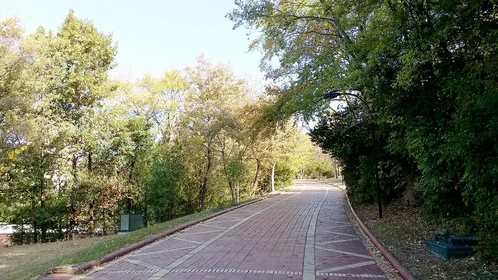
The half-mile brick walkway behind Bathhouse Row.
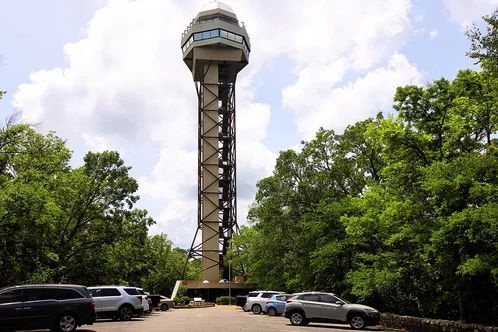
The city and the mountains from Hot Springs Mountain.
Eight historic bathhouses, built between the late 1800s and the 1920s — a national park you walk through on a city sidewalk, with no entrance gate and no admission fee.
The largest and most ornate building on the row. It opened in 1915 and now serves as the park's visitor center and a free museum — three floors of bath halls, a gymnasium with wooden lifting clubs, a music room, and the men's bath hall under a stained-glass ceiling of mermaids. Open daily from 9 a.m. to 5 p.m. and costs nothing.
Behind Bathhouse Row runs the Grand Promenade, a half-mile brick walkway along the hillside. Shaded, quiet, and raised above the street, with views down over the bathhouses and the city. Stroller- and wheelchair-friendly, it connects to the park's trail network — about half an hour at a stroll.
As you walk north along the row, you will pass the Buckstaff, the only bathhouse in continuous operation since 1912 and still offering the traditional private bathing ritual, and the Quapaw, with modern public thermal pools. At the north end sits the Superior Bathhouse — now a brewery, the only brewery in a national park, brewing its beer with thermal spring water.
The grand twin-towered hotel that has anchored downtown since the 1920s. It is worth stepping into the lobby just to see it, even if you are not staying there.
A tall Art Deco tower that is one of the most recognizable buildings in the city skyline, near the Arlington at the north end of Central Avenue.
Between the buildings, look for the Hot Water Cascade, where the spring water runs open down the hillside, and the public fountains where you can fill a bottle or a jug with thermal spring water for free.
The American Art Gallery at 724 Central Avenue shows paintings, jewelry, pottery, sculpture, and Arkansas-made crafts — better souvenirs than anything in a gas station gift shop.
Shows work by dozens of local artists, along with the small gift shops and studios scattered along the street — hot sauce, handmade candles, and more.
On the first Friday of each month, the downtown galleries stay open late for the Gallery Walk, with new shows, refreshments, and crowds strolling from one gallery to the next. If your trip lines up with a first Friday, plan your evening around it.
The oldest bar in Arkansas, where gangsters drank during Prohibition. There are cafes for a slow breakfast, ice cream shops for the afternoon, and restaurants ranging from casual to fine dining.
The street has everything from barbecue joints that have been serving since 1928 to fine dining. Start with breakfast downtown, have lunch at a cafe on Central, and come back in the evening for dinner and live music.
Between the 1920s and the 1940s, Hot Springs ran wide open — illegal casinos, bootleggers, and visiting mobsters like Al Capone and Owney Madden. The museum tells that story across seven galleries, with guided tours running through the day.
Go early for the Fordyce — the museum is free and the best starting point, but it gets busy by midday, so arrive when it opens at 9 a.m. Wear comfortable shoes: Central Avenue looks flat, but the Promenade and the streets behind it climb. Parking is easy, with public lots and street parking around downtown. Bring a bottle for the spring water — the public fountains are free, and filling a jug is a local ritual. Allow half a day: the walk itself is short, but the museum, the shops, the galleries, and a long lunch will fill a morning or an afternoon easily. And come back at night — the bathhouses are lit, the restaurants fill up, and live music drifts out of the bars.